The physical systems of skiing
A first principles approach
March 13, 2026
In this brief overview, I hope to cover the main physical systems of bodies and forces that are at play when skiing. The aim of this knowledge is to give the reader a truly bottom-up understanding of the physics at work, so that the different techniques and "cues" that one learns are grounded in actual understanding instead of memorization.
Gravity
Fundamentally, skiing is the release of the potential energy that the lift (or yourself, if you're a touring beast) expended to move you from the bottom of the slope to the top of the slope. Recall that gravitation potential energy is simply:
Since the mass and gravitational acceleration aren't really changing, the potential energy we gain, is proportion to the distance we go up by, , or
In practice, since skis lose very little energy from friction with the snow, that means that if you're on edge, you can go to almost the same height on a different slope - useful for thinking about traverses.
Pizza and french fry
Let's make our model a bit more complex - now we have two rectangles making contact with the ground. The idea of the pizza actually combines two spatial changes from the french fry to cause one to stop: in the visualization below, you need rotation about and , as well as rotation about
The new position of the skis now has normal vectors ( and ) that are net behind - this is what reduces your speed, since the snow is pushing against the skis in the direction of and .
Edging
This is a place where my understanding has been updated after doing a deeper analysis of the subject. Before, I had assumed something with static friction to be the reason for why edging works, but now I see it's simply force vectors (obviously still transmitted through friction).
Above, we modeled the ski simply as two rectangles, but now we add the edge as a separate element to consider. The edge allows us to more cleanly modulate between two modes of interaction with the snow, being "on edge" and "side-slipping". In essence, being on-edge means the net force generated by the uphill component of the normal force of the edge is larger than the downhill component of gravitational force.
To model this, let's consider a simplified model of a slope with a single ski edge on it, and assume that the snow will compress a certain amount normal to the angle at which the ski is on the slope (shown here as ~10px). The key insight here is twofold: first, note that even if gravity points straight down, the actual component you need to fight is the downhill component (), and second, note that the normal force of the slope changes depending on your edge angle, and that affects the "uphill" component of the normal force. The higher your edge angle, the large the uphill component of the normal force becomes, until you get to a point where it overcomes the downhill component of gravity, and you're not falling anymore.
Of course, you don't always want to be on edge, and any good skier is able to shift on and off edge automatically. A great drill for this (shoutout PYANG) is to just set up on a slope (start with a shallow one), and practice tilting your skis until you find the angle at which you start / stop slipping. This depends heavily on the type of snow, how sharp your own edges are, how heavy you are, and the angle of the slope, so a good skier is able to subconsciously detect all of those variables and apply it to their mental model to hone in the boundary condition between "on-edge" and "side-slipping". With practice, you'll be able to as well.
Honestly, once you've mastered edging, you're probably better than 90% of skiers on the mountain. You'll notice that a lot of skiers seems to spray up snow as they go down the hill - that's bad edge management. Being on-edge is fundamental to being in control while skiing, and without getting a good grasp of this one, you won't get far.
(As a disclaimer, there's a lot more sophistication we can add to the model above, like the compression behavior of the snow or different shapes of edges to simulate dullness, but I think the elbow point of knowledge is here).
Sidecut, camber, and carving basics
Skis used to be straight pieces of wood, until the Slovenians had the cheeky idea to overhaul the design. Manufacturers had toyed with narrowing the waist of skis since the 1960s, but the Elan SCX in 1993 really set the stage for modern skiing. The brilliant folks at Elan realized that with a deep sidecut, the edge of the ski turns into a little arc, and if the ski simply follows that arc (which it should if you're on-edge), you turn automatically, no force necessary!
Ski manufacturers provide a "turn radius" for any ski they manufacture, which is based on the geometry of the unloaded ski. A deeper sidecut means the size of the circle that the arc approximates is smaller, so the "turn radius" (simply the radius of that circle) gets shorter. Something to note here is that this sidecut changes shape as the ski is bent - the more you bend the ski, the more dramatic the effective sidecut, and the smaller the turn radius. This is where another measurement, the camber of the ski, also comes in. The camber is basically how curved the ski is lengthwise.
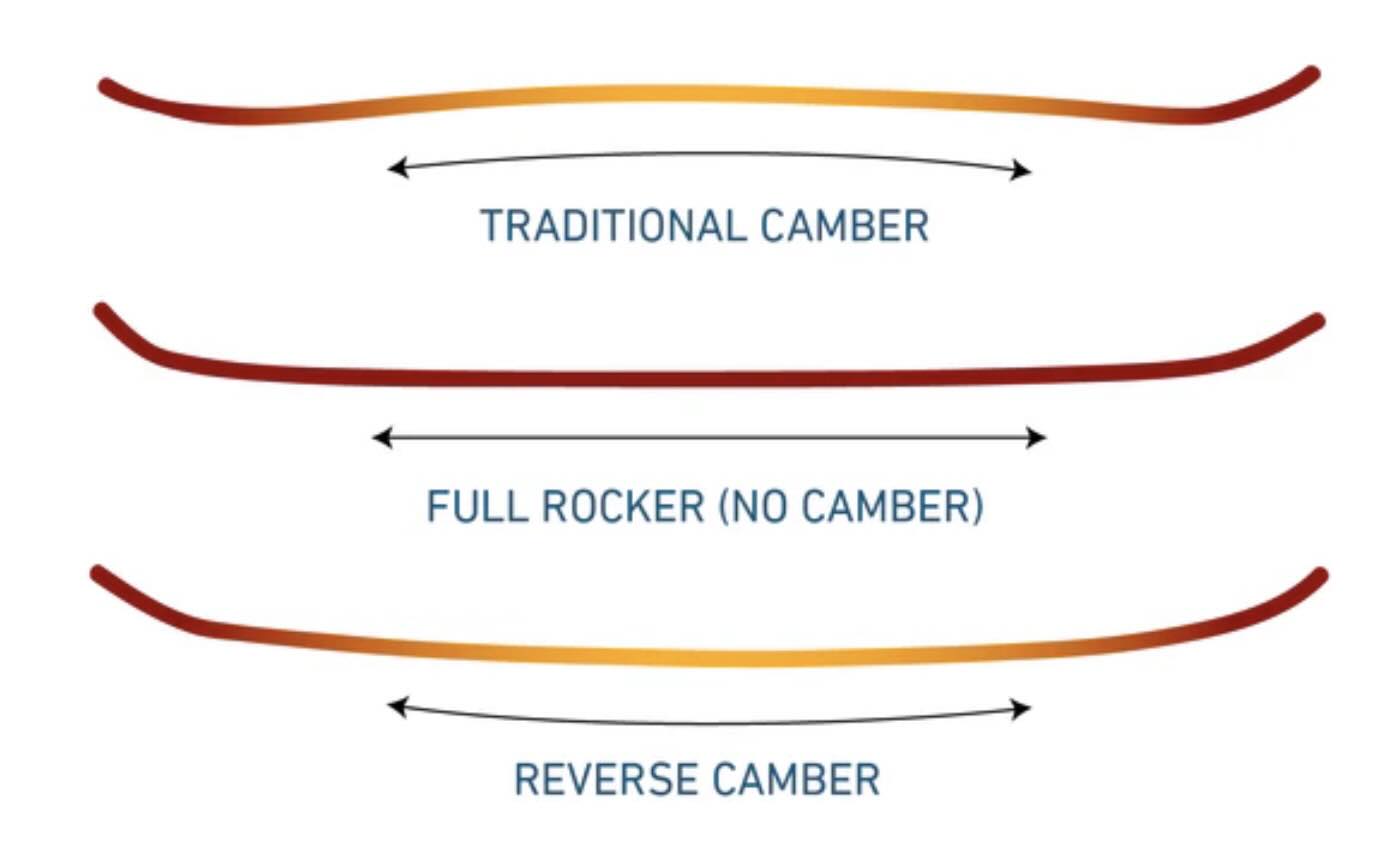
The camber basically gives you a free reduction in turn radius, since the sidecut becomes more dramatic once you load the ski with your weight and the camber flattens.
This ski shop nerdiness is important once we start talking about carving. Carving is one of the initial "holy grails" of skiing, in my opinion. When I was learning, the first phase of my progression was trying to dial in the carve, because otherwise, you're left in the dust by your friends (again, shoutout PYANG). As mentioned before, carving is fundamentally just continuously being on edge (when turning at least, I know someone is going to argue that when you link turns, you're technically not on-edge when you transition between sides). As we talked about above, your ski slips when the uphill component of the ski edge normal force isn't enough to overcome the downhill component of gravity. Now, since we're moving, there's an additional downhill component from the momentum of the skier that you also have to overcome.
Recall there's only really two inputs to edging efficacy: edge angle and normal force. This means that when you're trying to carve, the only two inputs that directly affect the quality of your edging are how hard you push down on the skis and the edge angle. You can carve on anything (even ice) if you have enough strength and a steep enough edge angle (look at the Olympics).
Boot flex
Another equipment nuance that you may have noticed when renting / shopping is the flex rating of boots.